
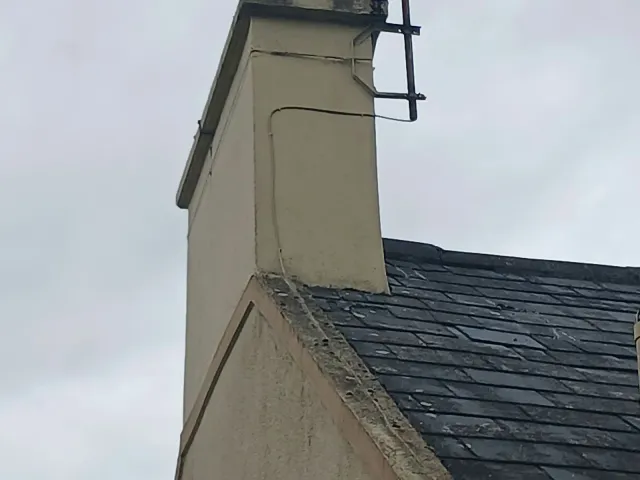
Lead flashing and chimneys in Waterford.
Where a roof meets a chimney or a wall is where most leaks begin. Lead dressed properly keeps that joint dry for decades, and the stack itself has to be sound for it to work.
Every joint is a weak point
A plain slope of slate or tile sheds water without help. Trouble starts wherever something interrupts it: a chimney stack, a wall that the roof butts up to, a dormer cheek, a valley where two slopes meet. At each of those, the roofing has to be joined to something rigid, and lead is the traditional way to do it.
Lead is soft enough to be dressed to the shape of the junction and tough enough to last a lifetime when it is fitted well. It is held at the top by a chase cut into the masonry, sealed with mortar or sealant, and lapped over or under the covering so water is always led away and never in. Done badly it lifts, splits or lets water run behind it.
A chimney stack adds its own problems. Mortar joints open up, the render cracks, and the pot and cap let rain straight down the flue. A stack that soaks water will send damp into the chimney breast inside, and that is often mistaken for a roof leak. Repointing, a new flaunching and a proper cowl can end it.
A valley is the other big one. Where two slopes meet, a lead or membrane lining carries the water of both, and moss, leaves and age block it. Relining a valley means lifting the covering either side, so it is a larger job than people expect and is priced as such.
The work we do at the joints.
New lead flashings
Code 4 or Code 5 lead cut, dressed and fixed into a cut chase, then sealed.
Chimney repointing
Open joints raked out and repointed, and cracked render repaired.
Flaunching and cowls
A fresh sloped mortar bed round the pots and a cowl to stop rain dropping down the flue.
Valley relining
A new lead or membrane lining along the valley, with the covering relaid either side.
Abutments
The line where a roof meets a side wall or a higher roof, flashed with stepped or continuous lead.
Chimney removal or lowering
Where a stack is no longer used, taking it down and making good the roof, subject to the survey.
What each price takes in.
The quote is one fixed sum, so the bill at the end matches the paper you signed.
Included in every job
Quoted separately
What this usually costs.
| Service | Indicative price (2026) | Typical duration |
|---|---|---|
| Chimney Repairs | €800–€3,500 | 1–3 days |
| Valley Reconstruction | €1,200–€4,500 | 2–4 days |
These are 2026 guide ranges and not a quotation. How big and steep the roof is, what it is covered with, how we get to it and the state of the timber beneath all shift the figure. What you pay is the sum written down after the survey, and 13.5% VAT is added for homes.
From the first look to the handover.
Look
The flashing, the stack and the covering around them are examined from the roof and from inside.
Written price
One fixed figure for the lead, the masonry work and the access.
Work
Old flashing off, chases cut and cleaned, new lead dressed and sealed.
Check
The joint is checked, the site is cleared and the guarantee is issued.
What Waterford homeowners ask us.
Why do chimneys leak so often?
Because they stick up into the weather on all sides and have a joint with the roof. Open mortar, cracked render, failed flaunching and tired lead all let water in.
How much does chimney work cost?
As a 2026 guide, chimney repairs run €800–€3,500 plus VAT, taking 1–3 days. Valley reconstruction is €1,200–€4,500 plus VAT over 2–4 days.
Is lead better than sealant?
Lead lasts far longer. A line of sealant is a short-term patch that cracks as the materials move, and it is not a substitute for a dressed flashing.
How long does lead last?
Properly fitted, it can last for decades. Failures are nearly always down to fixing or detailing, not the metal.
Can you tell whether the damp is from the chimney?
Often, yes. The survey checks the stack, the flashing and the breast inside before a repair is suggested.
Does lead theft matter?
Lead is valuable and is sometimes stolen from exposed roofs. If yours has gone, say so, because the report supports an insurance claim.
Related roofing jobs.
Roof Repairs
Water through the ceiling or slates on the lawn. We trace the entry point and mend that, rather than covering up the mark.
Roof Inspections
A written report with photographs, from the slope and the attic, setting out what the roof needs and what it can do without.
Flat Roofs
Flat roofs over extensions, garages and dormers, re-covered in EPDM or GRP and set to a fall so the rain drains away.
From the city to the coast, we work throughout Waterford. Surveys are free, quotes are fixed and written, and the finished work is guaranteed on paper.
Get your roof
looked at.
Tell us what the roof is doing and roughly where in Waterford it is. Someone looks at it for free and a fixed written price follows. Send the form below.